Love this topic and the questions you pose regarding it. I think your decision to narrow your focus to property crime and sex crime was wise; it might be even better to limit it to property crime. Having had the time to focus only on property crime, it streamlined your theoretical considerations (Wark, Lessig) as well. With your research, you are able to touch the abstract and the very concrete – much in line with Deleuzian thinking. It was astute also to frame the entire discussion using Deleuze’s virtual/actual concept-pair. Your effort to make connections between virtual worlds and RL was critical in this discussion, highlighting the question of how the former is re-shaping the latter, or at least the way we and (vs.) regulatory institutions apprehend the latter. These connections also bring up interesting questions regarding how virtual worlds and RL are each incorporated into the other – how their might be an underlying decision to focus on one as the ‘container’ of the other – which one? Is it Wark’s revisioning of the world through the virtual – freeing up the actual from objectification/commodification, or is it the colonization of virtual worlds like Second Life by the same oppressive vectoralist class that has chained information (the elemental unit) in RL?
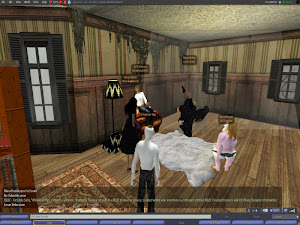
It was also an important move you made to emphasize that SL is a unique virtual world in that it’s focus is social engagement rather than gaming, which make the issues at hand even more critical. This could become an important line of thought if you want to emphasize the question of containment and colonization raised above. The “literalism” or “realism” of SL virtuality – its synthetic economy, as you called it, included – drives home the fact that virtual worlds and RL, the virtual and actual are continuous. Here your excellent choice to cite a blogger who exclaimed that “they” want to “regulate our fantasies, our minds” is relevant.
Some points for improvement. I would clarify a bit better your use of virtual/actual and possible – these are difficult distinctions that need careful explanation. Overall, while your theoretical content and the quantity of it are perfect for the subject matter and the length of your discussion (and this is a great accomplishment), you would do better to refer back to it as you move through your examples/ethnographic material. Sometimes it works best to raise theoretical considerations as you go, or to accumulate the pieces of a theoretical statement until arriving at a good point in the material to fully explain it. The same thing goes for the research questions with which you opened your presentation. Although it was great for the audience to be able to read and hear the questions you were considering while conducting your research (it helps us to orient ourselves to your discussion and follow it without straying), you could return to the questions more in the course of discussion. Also, it is a common problem of disconnect to make more claims for which you are prepared to give us a payoff. By disconnect, I mean between theory and the material. That being said, it would be a big enhancement to get to the material as soon as possible, getting to the central issue/conflict of each example and providing only some suggestive details.
More superficially, powerpoint should be used sparingly for text – and text that is projected should not be read only sparingly by the presenter. For example – key phrases from citations of bloggers and theorists. Also, it’s important to practice the timing of the presentation – it takes a lot of experience to learn how long it takes to get through various quantities and types of material. For me, the rule has been to present less but allude to what is left out. We were all curious to see your videos and hear more about the sex crimes, but 40 minutes seemed to pass almost without your knowing. Please post the video on your blog, or better yet, on YouTube with a unique tag so that I can link it to this presentation feedback blog. Also, here’s a video you should check out:
.

Subscribe to:
Post Comments (Atom)
1 comment:
Congratulations on a wonderful presentation!!! Your topic of virtual world crime was engaging and allowed for a great compare/contrast of SL to RL. Intellectual property and sex crimes in SL are both fascinating subjects and it was very nice to see how these issues are affecting RL. I also felt your presentation was very easy to follow as both the abstract and concrete ideas in your presentation seemed to flow naturally. Although, you might have incorporated the theorectical ideas from Wark and Lessig in more integrated format as opposed to solely in the beginning. I say this because as a person in the audience I was excited to learn more about your actual findings on virtual crime in SL and this came later in the very end. However, when you did move to that part of the presentation it was great to hear your analysis of virtual world crime in SL, its possibilities and solutions. Personally, I think the Linden Lab has too much power in some areas and not enough in other areas which makes it hard for me to believe SL really fosters a true democratic virtual society.
I could tell that you were a bit nervous because you kept clicking your pen throughout the presentation. I've done this in the past too. If you are nervous try holding on to something less noticeable like a paper clip that doesn't distract the audience while you are presenting your information. But overall, I think you did a superb job and I truly believe that your presentation was one of the best. Happy New Year, Will
Post a Comment