Linsday – Spectatorship
Outstanding presentation. At the onset you placed it within multiple frames – 1) you wanted to avoid the objectifying tendencies of other theoretical considerations of the gaze, 2) that you were reading your presentation, as it were a script and ‘true to form’ and consistent with the matter at hand, 3) you placed yourself and your presentation within the mix of conversations and events that you encountered in your research, hoping to create for us an encounter, including us in the frame, and 4) you did not want to be looked at as a (‘loser’?, ‘insane person’?, ‘fool’? – I can’t remember).
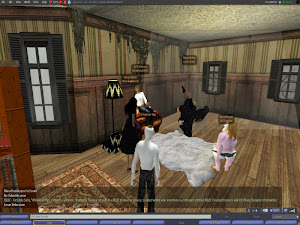
Excellent use of materials: SL wiki regarding camera use, Make My Day reality TV show, your richly detailed and multi-framed experience of looking and being looked at in the sex club, your mobile gaze as shopper, makeovers and socially acceptable interventions on one’s appearance, the guide to SL tourism and the Devil’s Moon.
Finally, your closing statements regarding unknown and unknowable ways of looking (your elusive and un-objectifiable subject matter) were innovative and astute. If anything, you could leave more time for this concept to breathe. You also talk about felt experience and spectatorship, as well as participating in the image. Do you therefore mean the haptic, rather than synaesthetic gaze? If it’s the latter, what more can you say about how other senses are implicated in this gaze?
Some points for improvement: reduce the amount of theory. You might start by abbreviating the panopticon discussion. Still more, although the panopticon discussion is perfectly relevant for a related discussion of reality tv and participatory culture and experience economies via regimes of looking (and framing and genre-construction and genre-policing), it seems to follow its own path, only glancing off your other ideas on posthuman embodiment and self-spectatorship and immersive seeing (haptic looking). You seem to be saying a lot more about spectatorship than power/surveillance, and overemphasis of the panopticon, etc might be misleading. You do incite us to think about whether SL itself is a framed experience that is commercializing, incorporating, commodifying; what then, is the relationship of the image-object commodity (the spectacles of capitalism) and the kind of image-experience or looking-experiencing that you are describing? How would you theorize animations, in this context? You might find Lev Manovich’s article “Generation Flash” useful.

Subscribe to:
Post Comments (Atom)
1 comment:
Hot!
Post a Comment